 Southern Maine Criminal Lawyer Blog
What Happens When You Get Your First OUI in Maine

If you are arrested for a first DUI in Maine, you face a Class D misdemeanor charge. The penalties include a minimum $500 fine, a 150-day license suspension, and up to 364 days in jail. Maine calls this offense OUI – Operating Under the Influence – but it is the same as what most states call DUI. The process starts with a traffic stop and arrest. It moves through a BMV administrative hearing on your license. It ends with a criminal case in district court.
Maine’s OUI law is found in statute. You can face charges if your blood alcohol concentration (BAC) is 0.08% or higher. CDL holders face a lower threshold of 0.04%. Drivers under 21 face zero tolerance – any measurable BAC can trigger charges.
This article covers every stage of a first-offense OUI in Maine. We explain the arrest process, the penalties you face, how the court case works, common defenses, and the consequences many people do not expect.
The Traffic Stop and OUI Arrest Process
A first OUI case in Maine begins at the roadside. An officer needs reasonable articulable suspicion to pull you over. Common reasons include swerving, speeding, running a stop sign, or an equipment violation like a broken taillight.
Once the officer approaches your vehicle, they look for signs of impairment. These include the odor of alcohol, slurred speech, bloodshot eyes, and difficulty producing your license and registration. If the officer suspects impairment, they will ask you to step out and perform field sobriety tests.
After the roadside evaluation, the officer decides whether to arrest you. If arrested, you are taken to the station for a breath test on the Intoxilyzer machine. Maine’s implied consent law means that by driving on Maine roads, you have already agreed to submit to chemical testing. Refusing the Intoxilyzer triggers an automatic administrative license suspension – separate from any criminal penalties.
At the station, you are booked, fingerprinted, and photographed. In our experience representing first-time OUI defendants in Maine courts, most people are released the same night on bail conditions. You are typically released to a sober driver. If no one is available, you may be held until you are sober enough to leave safely. Bail conditions usually include no alcohol use and no new criminal conduct.
Field Sobriety Tests and Chemical Testing
Officers use three standardized field sobriety tests at the roadside: the Horizontal Gaze Nystagmus (HGN) test, the walk-and-turn test, and the one-leg stand test. These tests are voluntary in Maine. You are not required to perform them. Refusing them does not carry the same consequences as refusing the Intoxilyzer.
The Intoxilyzer breath test at the station is different. This test falls under implied consent. Refusing it triggers an automatic 275-day license suspension for a first offense – longer than the 150-day suspension you would face with a failed test.
In accident cases, officers may request a blood draw instead of or in addition to a breath test. Blood tests are common when injuries are involved or when the officer suspects drug impairment.
Several factors can affect test accuracy. Medical conditions like GERD or acid reflux can produce falsely high breath readings. Improper calibration of the Intoxilyzer machine also affects accuracy. Failure to observe the required 15-minute deprivation period before testing can produce inaccurate results. Officer errors during field sobriety test administration can all become important to a defense strategy later.
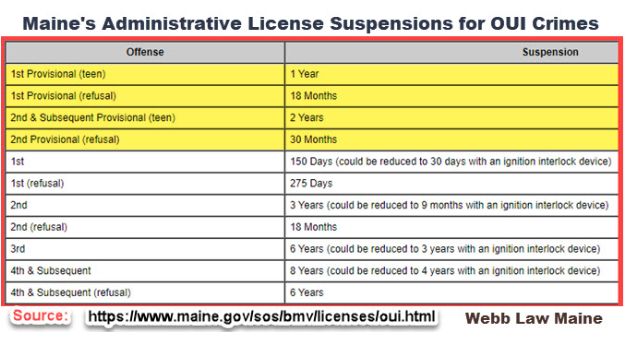
First-Offense OUI Penalties in Maine
A first OUI conviction in Maine carries serious penalties. The standard penalties include:
- A minimum fine of $500, plus surcharges that typically bring the total to $600 or more
- Up to 364 days in jail (though jail time is rare for a standard first offense)
- A 150-day license suspension
- Mandatory completion of the DEEP (Driver Education and Evaluation Program)
Penalties increase with aggravating factors. An aggravated OUI applies when your BAC is 0.15% or higher. It also applies if you had a passenger under 21, drove at excessive speed, caused an accident, or refused chemical testing. An aggravated first-offense OUI carries a mandatory minimum 48 hours in jail and a longer license suspension.
Many clients are surprised to learn that the fine is often the smallest part of the financial impact. Court costs, attorney fees, the DEEP program, increased insurance rates, and reinstatement fees add up quickly.
License Suspension and Reinstatement
A standard first-offense OUI in Maine triggers a 150-day license suspension. Aggravated offenses and test refusals carry longer suspension periods. This suspension is administrative – it comes from the Bureau of Motor Vehicles (BMV), not the court.
You have 10 days from the date of your arrest to request a BMV administrative hearing to challenge the suspension. Missing this window means you lose the right to contest it. In our experience, many people do not realize this deadline exists until it has already passed. Acting quickly is critical.
To get your license back after the suspension period ends, you must complete several steps:
- Finish the full suspension period
- Complete your DEEP assessment and any required treatment
- File SR-22 insurance (proof of financial responsibility) with the BMV
- Pay all reinstatement fees
One important detail: Maine does not currently offer a hardship or work license during an OUI suspension for first offenses. You cannot drive at all during the suspension period, regardless of your work or family needs.

The Court Process for a First OUI Charge
A first-offense OUI in Maine is a Class D misdemeanor. Your case will be heard in district court. The process typically moves through several stages over two to six months, depending on the circumstances.
The main stages include:
- Arraignment – You appear in court, hear the charges, and enter a plea
- Discovery – Your attorney obtains police reports, test results, dashcam or bodycam footage, and calibration records
- Motion hearings – Your attorney may file motions to suppress evidence or challenge the legality of the stop
- Resolution – The case ends through a plea agreement, a trial verdict, or a dismissal
One fact that concerns many first-time defendants: a conviction creates a permanent criminal record in Maine. OUI convictions cannot be expunged. This is why it is worth exploring every defense option before accepting a plea.
What to Expect at Your Arraignment
Your arraignment is typically scheduled within a few weeks of your arrest. This is your first court appearance, and it can feel overwhelming if you have never been inside a courtroom before.
At the arraignment, the judge reads the charges against you and asks you to enter a plea. Most experienced OUI attorneys recommend pleading not guilty at this stage. A not guilty plea preserves all your defense options. It does not mean you are claiming innocence – it means you are giving your attorney time to review the evidence and build the strongest possible case.
Bail conditions set at the time of your arrest typically remain in place. These usually include no alcohol use and no new criminal conduct. Violating bail conditions can lead to additional charges.
If you do not yet have an attorney, the arraignment is not the time to make major decisions about your case. You can request a continuance to give yourself time to hire legal counsel.

Common Defenses for a First OUI in Maine
Every OUI case has unique facts. An experienced attorney reviews the specific details to identify the strongest defense strategy. Common approaches include:
- Challenging the traffic stop – The officer must have had reasonable articulable suspicion to pull you over. If the stop was unlawful, all evidence gathered afterward may be suppressed.
- Contesting field sobriety test administration – Officers must follow standardized procedures. Errors in how they administered or scored the tests can undermine the results.
- Challenging breath test accuracy – Intoxilyzer machines require proper calibration and maintenance. The officer must observe you for 15 minutes before testing. Medical conditions like GERD can produce falsely elevated readings.
- Rising BAC defense – Your BAC may have been below 0.08% while you were driving but rose above that level by the time you were tested at the station. Alcohol takes time to absorb into your bloodstream.
- Procedural errors – Failure to properly advise you of your rights, errors in paperwork, or gaps in the chain of custody for blood samples can all weaken the prosecution’s case.
No attorney can guarantee a specific outcome. Results vary based on the individual facts of each case. But identifying weaknesses in the state’s evidence is the foundation of an effective defense.

How a First OUI Affects Your Life Beyond Court
The court penalties are only part of the picture. Many clients tell us the collateral consequences cause them more worry than the fine or suspension.
Employment – An OUI conviction shows up on background checks. It can affect your current job and limit future opportunities. This is especially true in fields that require professional licensing, security clearances, or a clean driving record.
Auto insurance – Your rates will increase significantly after an OUI conviction. Most insurers raise rates for three to five years. You will also need to carry SR-22 insurance, which adds to the cost.
Education – A conviction can affect college applications and financial aid eligibility. Some scholarship programs disqualify applicants with criminal records.
Travel restrictions – Canada treats OUI as a serious criminal offense and routinely denies entry to people with DUI convictions. This restriction can last ten years or more.
DEEP program – Maine requires all OUI offenders to complete the Driver Education and Evaluation Program. This involves a substance abuse evaluation. You may need to enter a treatment program, depending on the results. The program takes time and money to complete.
Personal toll – The stress, embarrassment, and strain on personal relationships are real. Many first-time defendants describe the experience as one of the most difficult periods of their lives.
Understanding these consequences early helps you make informed decisions about how to handle your case.
Talk to a Maine OUI Defense Attorney About Your Case
Facing a first OUI charge in Maine is stressful and confusing. The decisions you make early in the process matter greatly. The choices you make before your arraignment can shape the outcome of your entire case.
Webb Law Firm handles first-offense OUI cases throughout Maine. We understand the anxiety that comes with facing criminal charges for the first time. We also know that the 10-day BMV hearing deadline, the discovery process, and the available defense strategies all require prompt attention.
If you or someone you care about was recently arrested for OUI in Maine, call Webb Law Firm. We discuss your specific circumstances. Early legal counsel gives you the best chance to protect your license, your record, and your future. Every case is different, and the facts of your situation matter. If a spouse gets a DUI, family liability concerns may also arise, and we can discuss those as well.

Frequently Asked Questions About First-Offense OUI in Maine
Will I go to jail for a first OUI in Maine?
Jail time is rare for a standard first-offense OUI in Maine. Most first-time offenders receive a fine, license suspension, and the DEEP program requirement. However, if your case involves aggravating factors – such as a BAC of 0.15% or higher, a passenger under 21, or an accident – you face a mandatory minimum of 48 hours in jail.
Can I get a first-offense OUI dismissed in Maine?
Dismissal is possible but not guaranteed. Common paths to dismissal include challenging the legality of the traffic stop, proving errors in breath test administration, or identifying procedural violations. An attorney can evaluate your case to determine whether the evidence supports a motion to dismiss or suppress key evidence.
How long does a first OUI stay on your record in Maine?
A first OUI conviction stays on your criminal record permanently in Maine. No expungement process exists for OUI convictions. The conviction also remains on your driving record and is considered a prior offense if you are ever charged with OUI again.
Can I still drive after a first OUI arrest in Maine?
Your license faces a 150-day administrative suspension. Maine does not offer a hardship or work license during OUI suspension for first offenses. You cannot legally drive during the suspension period. You have 10 days from your arrest to request a BMV hearing to challenge the suspension.
Do I need a lawyer for a first-offense OUI?
You are not legally required to hire a lawyer. But an OUI carries serious consequences including a permanent criminal record, license suspension, and significant financial costs. An experienced OUI attorney can identify weaknesses in the state’s case. They protect your rights at the BMV hearing and work toward the best possible outcome based on your specific facts.