 Southern Maine Criminal Lawyer Blog
Why You Need an Experienced OUI Defense Attorney in Portland, Maine
You need an experienced defense attorney if you were arrested for DUI, OUI, or DWI in Portland, Maine. A qualified attorney understands Maine’s OUI laws and the Cumberland County court system. Maine calls the offense “Operating Under the Influence.” Whether you search for a DUI attorney, DWI attorney, or DUII attorney, the charge is the same. The State can prosecute your case two ways: as a per se OUI based solely on your blood alcohol level, or as an impairment-based OUI. The prosecution builds impairment cases on officer observations and field testing. Each theory demands a different defense approach.
Your choices now affect your license, your job, and your long-term record. Administrative suspension deadlines start running immediately. Critical evidence like dashcam footage and calibration logs can disappear if no one requests it promptly. A Portland OUI attorney who acts early can preserve defense options that vanish within days. Call Webb Law Firm at (207) 283-6400 for a free consultation.
OUI vs. DUI in Maine
OUI, DUI, DWI, and DUII all refer to the same criminal offense in Maine. The state legislature chose “Operating Under the Influence” as the official term. It is defined in operating under the influence. Every drunk driving or drugged driving charge filed in Portland appears on the docket as OUI.
The confusion is understandable. Most states use “DUI” (Driving Under the Influence). Several use “DWI” (Driving While Intoxicated) or “DUII” (Driving Under the Influence of Intoxicants). Maine is one of a handful of states that uses “OUI” because the statute covers “operating” a vehicle, not just “driving.” This distinction matters. Under Maine law, you can be charged with OUI even if the vehicle was not moving. The State only needs to show you were operating or attempting to operate it.
Whether you search for a DWI attorney Portland, a DUII attorney Portland, or a DUI lawyer in Portland, you are seeking the same thing. You need an attorney who defends OUI charges under Maine law. The legal elements, penalties, and defense strategies are identical. What matters is finding counsel with real experience in Cumberland County courts. Your attorney should understand Maine’s OUI statute deeply.
What the Portland OUI Process Usually Looks Like
Most OUI cases follow a familiar path through the Cumberland County court system. Understanding what to expect at each stage helps you make better decisions. It also helps your attorney identify defense opportunities early.
Arrest and release. Portland police typically release you on bail with conditions after the arrest. In Cumberland County, standard OUI bail conditions often include no alcohol use and no operation of a motor vehicle. Sometimes a preliminary breath testing requirement applies. You may be required to surrender your license at the time of arrest.
Arraignment. Your first court appearance at Portland District Court usually happens within days of the arrest. The court reads the charges and you enter a plea. Most defense attorneys advise entering “not guilty” at this stage to preserve all options. Having counsel before arraignment is critical. The decisions made at this hearing shape the rest of your case.
Pretrial conferences and negotiations. During pretrial conferences, your attorney and the prosecutor exchange discovery. This includes police reports, dashcam and bodycam footage, testing records, calibration logs, and witness statements. Your defense attorney reviews every detail for procedural errors, inconsistencies, and constitutional violations.
Motions. If the evidence review reveals problems, your attorney files motions to suppress illegally obtained evidence. Your attorney may also file motions to exclude unreliable testimony. Motion practice is covered in more detail in the defense strategy section below.
Trial or plea. Most Portland OUI cases resolve during pretrial negotiations. But trial readiness is what drives better outcomes. When the prosecutor knows your attorney is prepared to go to trial, plea offers improve.
Sentencing and reinstatement. If the case results in a conviction or plea, sentencing follows. License reinstatement involves separate steps through the BMV. This includes DEEP completion and potentially ignition interlock installation. A DUI defense attorney in Portland should be involved from the start. These downstream consequences should be factored into every strategic decision.

Where Portland OUI Cases Are Handled
Portland-area OUI cases commonly run through the courthouse at 205 Newbury Street, Portland, ME 04101. The Portland District Court – part of Maine’s Unified Criminal Docket – handles most misdemeanor OUI charges in Cumberland County. Arraignments, pretrial conferences, motion hearings, and many trials take place in this building.
Felony-level OUI cases follow a different track. Third or subsequent OUI offenses are charged as Class C crimes under Maine law. These cases may be handled in Cumberland County Superior Court. The procedural requirements, timelines, and stakes increase significantly at the felony level.
John Webb regularly appears at the Portland courthouse. He is familiar with local prosecutors, court procedures, and the expectations of Cumberland County judges. This familiarity matters for negotiation strategy. Knowing how a particular prosecutor evaluates cases or how a judge handles suppression motions informs tactical decisions throughout the case. Cases from surrounding communities like South Portland, Westbrook, Scarborough, and Cape Elizabeth often funnel through this courthouse. Webb Law Firm defends clients from across the greater Portland area.
Two Tracks Hit You at Once: Court Plus BMV
An OUI arrest usually creates two separate problems that run on parallel timelines:
- The criminal court case – this determines your record, fines, potential jail time, and court-ordered license suspension.
- The administrative license suspension through the Bureau of Motor Vehicles – this starts before your court case resolves.
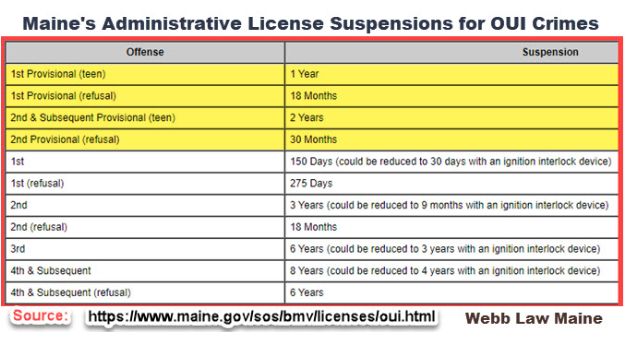
The BMV suspension is automatic and begins shortly after your arrest. For a first offense with a failed chemical test (BAC at or above 0.08%), the administrative suspension is typically 150 days. If you refused the test, the suspension jumps to 275 days. These administrative suspensions are separate from any court-ordered suspension that may follow a conviction.
The two tracks have different burdens of proof and different timelines. The criminal case requires proof beyond a reasonable doubt. The BMV proceeding uses a lower administrative standard. This means you could win your criminal case and still face a license suspension through the BMV. Or you could lose the BMV proceeding and still win at trial.
Early action may be critical. In some situations, requesting an administrative hearing within days of the arrest can preserve options. You can challenge the suspension. A Portland OUI attorney must fight on both fronts from the start. Protecting your driving privileges and your record is essential.
Implied Consent: Chemical Testing and Refusal
Maine’s implied consent law is the foundation of most OUI chemical testing. Under implied consent, any person who operates a motor vehicle in Maine is deemed to have consented to chemical testing. This applies if an officer has probable cause to believe they are operating under the influence. The officer may test blood, breath, or urine.
Refusing the test carries serious consequences. A first refusal triggers a 275-day license suspension. This is significantly longer than the 150-day suspension for a failed test. The refusal itself can also be introduced as evidence at trial. Prosecutors argue that you refused because you knew you were impaired.
However, the implied consent process has specific legal requirements. Officers must follow these requirements before requesting a test. Before requesting a test, the officer must provide specific warnings about the consequences of refusal. If those warnings were inadequate, coerced, or missing, the defense may challenge both the suspension and the test result. The refusal itself may be inadmissible.
For a per se DUI attorney, implied consent is a critical battleground. Per se OUI charges depend entirely on the chemical test result. If the test is thrown out due to an implied consent violation, the per se theory collapses. In refusal cases, the State loses the per se option entirely. But the State gains the refusal evidence – creating a different strategic landscape that an experienced defense attorney must navigate.
Per Se OUI vs. Impairment-Based OUI in Portland
Maine prosecutes OUI cases under two distinct legal theories. Understanding the difference is essential to building an effective defense.
Per se OUI is based solely on your blood alcohol concentration. If your BAC registers at or above 0.08%, the State does not need to prove you were actually impaired. The number alone is enough. Lower thresholds apply to commercial drivers (0.04%) and drivers under 21 (zero tolerance).
Impairment-based OUI requires the State to prove that your ability to operate a vehicle was actually impaired. This may be impairment by alcohol, drugs, or a combination. This theory relies on officer testimony, field sobriety test performance, driving behavior, and other circumstantial evidence.
The distinction drives defense strategy. Per se cases hinge on the reliability and admissibility of the chemical test. A per se DUI attorney must understand Intoxilyzer 8000 science. This includes infrared spectroscopy, partition ratio assumptions, calibration requirements, and operator certification. In our experience handling per se OUI cases in Cumberland County, Intoxilyzer calibration records and operator logs frequently reveal procedural gaps. These gaps undermine the BAC reading.
Impairment-based cases depend on the quality of the officer’s observations and testing. Many Portland OUI cases involve both theories charged simultaneously. The defense must address each one. Weakening the per se theory through testing challenges strengthens the position. Also attacking the impairment evidence through field sobriety test analysis creates the strongest defense position.

Field Sobriety Tests and Roadside Investigations
Officers use roadside testing to build probable cause for an OUI arrest. The three standardized field sobriety tests (SFSTs) recognized by the National Highway Traffic Safety Administration are Horizontal Gaze Nystagmus (HGN), Walk and Turn, and One Leg Stand. NHTSA protocols require officers to administer each test following specific, standardized instructions.
A DUI defense attorney scrutinizes whether the officer followed these protocols precisely. Incorrect verbal instructions create problems. A testing surface that is uneven or sloped causes issues. Inadequate lighting matters. Adverse weather conditions affect results. All of these can invalidate results. Medical conditions – inner ear disorders, leg or back injuries, neurological conditions, and even age or weight – produce indicators that mimic intoxication. These have nothing to do with alcohol.
Portland officers sometimes use non-standardized tests like counting backwards or reciting the alphabet. These tests have no validated scientific reliability. They carry far less weight, though prosecutors still try to use them.
We have seen Portland OUI cases where the officer’s dashcam footage directly contradicted the field sobriety test report. The video showed steady balance and clear speech. The written report described stumbling and slurred words. Obtaining dashcam and bodycam footage early is critical. Video evidence often tells a very different story than the officer’s subjective observations.

DEEP: A Required Step for Many Drivers After an OUI
Many people do not realize how quickly DEEP becomes the bottleneck for license reinstatement. Maine’s Driver Education and Evaluation Program (DEEP) is administered through the Maine Office of Substance Abuse and Mental Health Services. Completion is required for license reinstatement in most OUI cases.
DEEP has two phases. The first is an education component – a multi-week course covering alcohol and drug awareness. This covers the effects of impaired driving and risk reduction strategies. The second phase is a clinical evaluation. A licensed counselor assesses whether you have a substance use disorder. Depending on the evaluation outcome, you may face additional treatment requirements. The program certifies your completion to the BMV.
The program costs several hundred dollars and the time commitment is significant. More importantly, scheduling delays are common. If you wait until after sentencing to enroll, you may lose months waiting for an available slot. You lose months when you could have been working toward reinstatement.
A Portland OUI attorney can advise on the optimal timing for DEEP enrollment. In many cases, starting the process early helps – even before the criminal case resolves. Early completion can align with your reinstatement eligibility date. This gets you back on the road sooner.
Ignition Interlock: When It Becomes Part of the Solution
Ignition interlock requirements vary by case history and suspension type. Under ignition interlock, an ignition interlock device (IID) may be required as a condition of license reinstatement. For a first offense with a BAC of 0.15% or higher, interlock is mandatory. Repeat offenses also trigger mandatory interlock requirements.
The device requires you to provide a breath sample before starting your vehicle. You must provide samples at random intervals while driving. If the device detects alcohol, the vehicle will not start. During a rolling retest, the device will log a violation. The typical interlock period varies by offense level. The monthly cost runs between $75 and $100 for lease and calibration fees.
Violations during the interlock period can extend the requirement. Violations include failed breath tests, missed calibration appointments, or evidence of tampering. These violations trigger additional consequences. However, interlock is not always purely a burden. In some cases, installing an IID can actually help. It may allow restricted driving privileges earlier than waiting out a full suspension period. For clients who need to drive to work or medical appointments, interlock can be the fastest path back behind the wheel.

What an Effective Portland OUI Defense Focuses On
A strong OUI defense is not one-size-fits-all. It starts with a thorough review of every piece of evidence. Focus on what the State must prove at each stage. An effective defense attorney examines the case through four lenses: the legality of the initial stop, the quality of the roadside investigation, the reliability of chemical testing, and the procedural leverage. Filing targeted motions creates procedural leverage. Weakness at any single point can unravel the prosecution’s case.
1) The stop
Did the officer have a legally valid reason to stop you? If the stop fails, the rest of the case can collapse.
The Fourth Amendment requires officers to have reasonable articulable suspicion before pulling you over. This suspicion must relate to a traffic violation or criminal activity. Common justifications include lane departure, speeding, or equipment violations. But many stops rely on subjective observations. These do not hold up under scrutiny. Pretextual stops, where an officer follows a vehicle leaving a bar and waits for any minor infraction, are legally permissible. But they are factually vulnerable. DUI checkpoints are rare in Maine and carry their own constitutional requirements. If the defense can show the stop lacked legal justification, a motion to suppress can eliminate all evidence that followed.
2) The investigation
Officers build probable cause with observations, questioning, and testing. Small facts carry big weight later, especially on video.
The transition from a routine traffic stop to an OUI investigation is a critical moment. Officers escalate from casual conversation to detention when they detect indicators. These indicators include alcohol odor or bloodshot eyes. But these observations are subjective. Miranda issues may arise if questioning continues after detention without proper warnings. In our experience, bodycam footage from Portland OUI stops frequently shows drivers who appear composed and coherent. This contradicts the officer’s written narrative of slurred speech and unsteady balance.
3) The chemical test or refusal process
If a breath or blood test exists, the defense should dig into procedure, reliability, timing, and foundation. If refusal is involved, the defense should evaluate whether the officer followed required warnings. Can the State use the refusal the way it wants to?
For per se OUI cases, the chemical test is the prosecution’s centerpiece – and its biggest vulnerability. The Intoxilyzer 8000 used in Maine requires regular calibration. The operator must hold current certification. The officer must observe you continuously for 15 minutes before the test. This ensures nothing enters your mouth that could affect the reading. The rising blood alcohol defense argues that your BAC was below the legal limit while you were actually driving. Your BAC rose above the limit by the time of testing. Blood draw cases raise chain of custody issues. Each of these challenges can undermine or exclude the test result entirely.
4) Motions that change leverage
Winning a motion can have a cascading effect on your case. A suppression issue can flip a “bad-looking” case into a fightable one quickly.
Motion practice is where experienced OUI attorneys separate themselves. A motion to suppress under the Fourth Amendment can exclude all evidence obtained after an illegal stop or arrest. A motion in limine can prevent the jury from hearing prejudicial evidence that lacks proper foundation. When the State loses a key motion, its case may become unprovable. That leverage drives favorable plea offers or outright dismissals. We have seen cases in Portland where a single successful suppression motion transformed the entire negotiation dynamic.

Negotiations and Plea Outcomes: What Actually Drives Results
Negotiations work best when the defense has leverage. Weak stop facts, shaky timelines, testing issues, credibility problems, or procedural failures create leverage. The concept of a “deal” matters less than the evidence problems. These problems force the prosecutor to take your defense seriously. Negotiating a Maine OUI plea bargain starts with case analysis, not guessing.
Choosing the Right Portland OUI Lawyer
If you search for a DUI attorney near me, a DWI attorney in Portland, or any OUI defense attorney in the area, use criteria that predict performance in OUI cases specifically:
Repeated OUI litigation experience in Maine courts. Occasional criminal defense work is not enough. You want an attorney who handles OUI cases regularly. Your attorney should understand the specific legal and scientific issues that arise in every drunk driving prosecution.
Comfort with technical evidence and testing procedures. OUI cases involve breath testing science, calibration records, and operator certification requirements. Your attorney should be able to challenge the Intoxilyzer 8000 results on technical grounds. Your attorney should not just argue generally that the test “might be wrong.”
Motion practice experience. Suppression and admissibility motions are where many OUI cases are won or lost. Ask whether the attorney regularly files motions. Does the attorney have a track record of winning them?
Familiarity with Cumberland County courtroom expectations. Local knowledge matters. An attorney who knows the prosecutors understands the court’s scheduling practices. An attorney who has appeared before the judges handling your case brings an advantage. Out-of-area lawyers cannot replicate this advantage.
Cross-examination skill. This is one of the most overlooked factors in choosing a DUI defense attorney. The arresting officer’s testimony is often the backbone of the State’s case. Effective cross-examination exposes inconsistencies. It can dismantle the prosecution’s narrative by comparing the officer’s report, video footage, and courtroom testimony.
Clear communication and early action. Your attorney should return calls promptly. Your attorney should explain the process in plain language. Your attorney should take immediate steps to preserve evidence and protect your rights.
Watch for red flags: any attorney who guarantees outcomes, lacks trial experience, or seems unfamiliar with Cumberland County courts is not the right choice. Webb Law Firm meets clients in Portland and across Southern Maine. Office locations make it easy to get answers quickly.

Why John S. Webb Is a Strong Fit for OUI Defense
OUI defense demands technical focus and courtroom experience. Attorney John S. Webb has spent years defending clients against OUI charges across Southern Maine. He has handled hundreds of cases that range from first-offense misdemeanors to felony-level third-and-subsequent charges.
John Webb’s training goes beyond standard criminal defense preparation. He has completed NHTSA Standardized Field Sobriety Testing courses – the same training police officers receive. This allows him to identify exactly where officers deviate from required protocols. He understands Intoxilyzer 8000 operation and infrared spectroscopy principles. He knows the calibration and maintenance requirements that the State must satisfy. A breath test result is admissible only if these requirements are met.
Webb Law Firm’s familiarity with Portland District Court and Cumberland County prosecutors is a practical advantage. Knowing how specific prosecutors evaluate OUI evidence informs every strategic decision. Knowing how judges rule on suppression motions informs strategy – from the initial case assessment through trial preparation.
In our experience defending OUI cases in Cumberland County, we frequently see testing procedure errors. When challenged, these errors significantly weaken the prosecution’s case. These are not theoretical problems. They are patterns we have documented across dozens of cases.
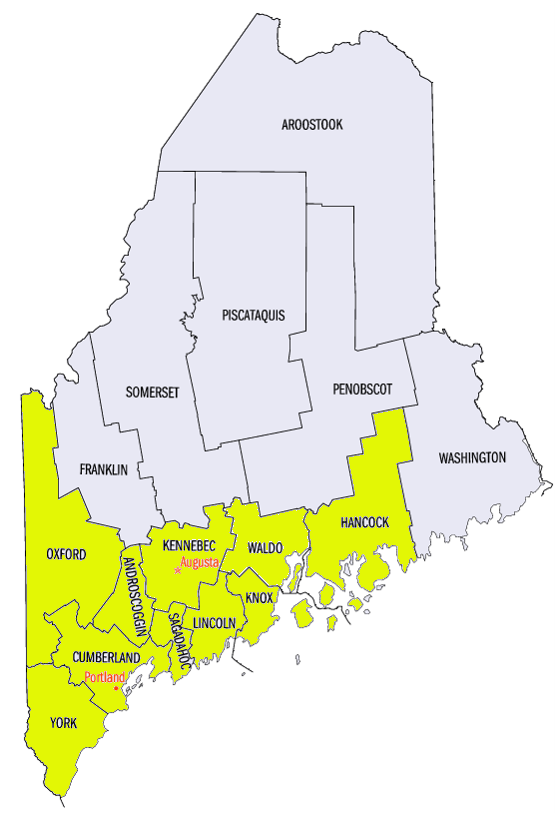
Webb Law Firm offers free consultations and serves clients across Southern Maine. This includes Portland, Biddeford, Saco, Scarborough, and South Portland. You can review John S. Webb’s background and training at our website and see examples of past case results. Every OUI case is different. The best way to understand your options is to speak with a Portland OUI attorney about the specific facts of your arrest.

Sealing and Long-Term Record Impact
Maine does not treat record relief the way many people assume. Under sealing of criminal records, courts may allow sealing of certain criminal records. OUI convictions have specific eligibility restrictions and waiting periods that limit access to this relief.
The practical consequences of an OUI conviction extend far beyond fines and jail time. Employers routinely run background checks. An OUI on your record can cost you job opportunities – especially in fields that require driving, security clearances, or professional licensing. Insurance rates typically spike after an OUI conviction. Rates may remain elevated for years. Perhaps most significantly, if you are ever charged with a subsequent OUI, the prior conviction triggers enhanced mandatory minimum penalties. These include longer license suspensions, higher fines, and potential felony charges.
An acquittal or dismissal can be sealed more readily than a conviction. This is another compelling reason to fight the charge aggressively. Do not accept the first plea offer. A skilled defense attorney evaluates not just the immediate consequences. Your attorney also evaluates the long-term impact on your record, your career, and your future.
What to Do Right Now After an OUI Arrest in Portland
The hours and days after an OUI arrest are when the most important defense opportunities exist. These opportunities are most likely to slip away during this time. Here is what you should do immediately:
Write down the full timeline while it is fresh. Record every detail you can remember: where you were, what you had to drink and when, the time of the stop, what the officer said, what tests were performed, and what happened at the station. Memory fades quickly. These details matter.
Save receipts, rideshare logs, and location history. Timestamped records from bars, restaurants, Uber or Lyft, or your phone’s location history can help establish a timeline. Your timeline can support your defense.
Avoid discussing the facts on social media or with casual contacts. Anything you say or post can become evidence. Limit discussions about your case to your attorney.
Get legal counsel before your arraignment. The administrative license suspension clock starts running immediately. Early action by a Portland OUI attorney can preserve options that disappear within days. These include evidence requests, administrative hearing deadlines, and strategic decisions about your plea.
If you are facing an OUI, DUI, or DWI charge in Portland, Maine, contact Webb Law Firm today for a free consultation. Attorney John Webb will review your case, explain your options, and start building your defense strategy. Call (207) 283-6400 or contact us online. Past results do not guarantee a similar outcome. Early, aggressive defense gives you the strongest position possible.
Frequently Asked Questions About DUI Charges in Portland, Maine
What is the difference between OUI, DUI, and DWI in Maine?
These terms all describe the same offense. Maine’s statute uses “OUI” – Operating Under the Influence – as the legal term. It is defined in operating under the influence. Other states use DUI (Driving Under the Influence), DWI (Driving While Intoxicated), or DUII (Driving Under the Influence of Intoxicants). If you are charged in Portland, the charge will appear as OUI regardless of which term you searched for. The penalties, defense strategies, and court process are identical no matter which label is used.
What are the penalties for a first OUI offense in Portland, Maine?
A first OUI conviction in Maine is a Class D misdemeanor. Penalties typically include a minimum fine of $500 and a 150-day license suspension. Mandatory completion of the DEEP program is required. Jail time is possible but not required for most first offenses. Aggravating factors increase penalties significantly. These factors include a BAC of 0.15% or higher, an accident, or a minor in the vehicle. The court may also impose probation and community service. These penalties are in addition to the administrative BMV suspension. The BMV suspension begins before your court case resolves.
Can I refuse a breathalyzer test during a Portland traffic stop?
You can refuse, but Maine’s implied consent law imposes significant consequences for refusal. Refusing a chemical test triggers a 275-day license suspension. This is nearly twice the 150-day suspension for a failed test. The prosecution can also introduce your refusal as evidence at trial. However, an experienced attorney can challenge whether the officer provided proper implied consent warnings. Your attorney can also challenge whether the request was legally valid. Refusal eliminates the per se OUI theory, which may benefit some defense strategies.
What is a per se OUI charge and how is it different from impairment-based OUI?
A per se OUI means the State charges you based solely on your BAC number – 0.08% or higher for most drivers. The prosecution does not need to prove you were actually impaired. An impairment-based OUI requires the State to prove your driving ability was diminished by alcohol or drugs. The State uses officer observations, field sobriety tests, and other evidence. Many Portland OUI cases involve both theories charged together. The defense approach differs: per se cases focus on challenging the test’s reliability, while impairment cases focus on the quality of the officer’s evidence.
How long will my license be suspended after an OUI arrest in Maine?
Suspension length depends on several factors. For a first offense with a failed breath test, the administrative suspension is typically 150 days. A test refusal triggers a 275-day suspension. Court-ordered suspensions upon conviction are separate. They may run concurrently or consecutively depending on the circumstances. Repeat offenses carry longer suspensions. Aggravated OUI charges can result in suspensions of a year or more. License reinstatement requires DEEP completion. It may require ignition interlock installation. An attorney can help you understand the specific suspension timeline for your situation.